Peptide Purity Screening: How Researchers Verify High Quality
✦
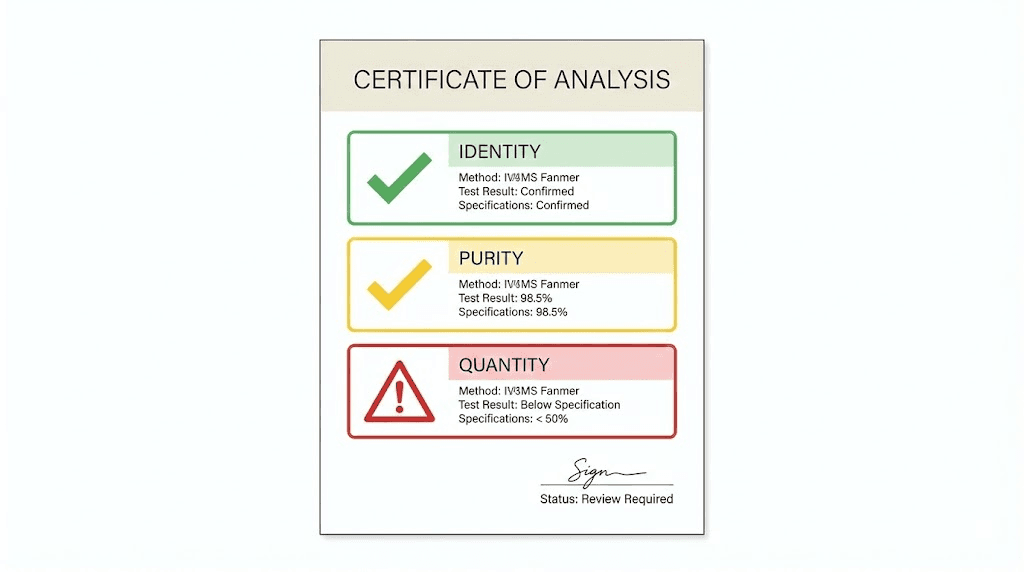
Peptide Purity & Yield Enhancing In Spps Purepep Blog The most rigorous quality, entailing cautious HPLC purification-- in some cases several rounds-- and extensive QC. Needed for measurable studies, structural biology, in vivo research study versions, and any kind of application where even small amounts of impurity can affect outcomes. This is the quality where the boost most sharply, because attaining that last 1-- 3% of pureness requires throwing out a significant portion of the manufactured material. A functional assay gauging downstream signaling-- or a structural research making use of NMR or X-ray crystallography-- demands the greatest pureness available. Crystallographers particularly often need ≥ 98% purity because also small pollutants can protect against crystal development or introduce condition into the crystal latticework. The reproducibility crisis in biomedical study is well-documented. Along with HPLC and MS, specialized labs might employ orthogonal strategies for added precision. For instance, capillary electrophoresis can be utilized to divide very hydrophilic peptides or to ascertain outcomes, and MALDI-TOF mass spectrometry can aid in mapping larger or customized peptides. Numerous peptide producers or providers will certainly give a COA (Certification of Analysis), as an example our bpc 157 tb 500 mix, that consists of the purity percent by HPLC and identification confirmation by MS for every batch.
- Certificate accessibility reduces uncertainty by enabling buyers to verify identity, purity, and traceability prior to acquisition, which supports reproducibility and decreases the danger of irregular batches.
- This matters because peptides are built one amino acid at a time via solid-phase peptide synthesis (SPPS).
- Identity verification verifies the particular secretagogue being studied.
- Palmetto Peptides provides third-party COA documents for its study peptide directory, with screening carried out by certified outside analytical laboratories.
- While identification, quantity, and sterility are uncomplicated and critical, purity is not something that is being completely & appropriately assessed today and is giving a false sense of security to customers in this area.
Facing Peptide Evaluation Difficulties? Boc Sciences Can Assist!
Poor-quality peptides (those with unseen impurities, incorrect sequences, or deteriorated parts) can lead to misleading information and irreproducible outcomes. In fact, proteins and peptides are among one of the most widely made use of laboratory reagents, yet research studies have revealed that their top quality is frequently poor, leading to poor information reproducibility. Starting with correct lab validation is for that reason an important part of a scientist's quality assurance operations. By insisting on peptides that come with confirmation of pureness and identification, scientists can substantially decrease the danger of experimental artefacts. This adds to the larger reproducibility crisis in science. Conversely, making use of peptides that have actually passed third-party laboratory validation aids make sure that the observed experimental effects are really because of the designated peptide and not due to contaminants or mistakes. These logical strategies are typical in peptide quality assurance and you will often get HPLC and MS information with a research peptide order. The key logical techniques for peptides include liquid chromatography (LC), usually HPLC, incorporated with mass spectrometry (MS) for precise molecular weight decision and sequence recognition. Various other techniques like electrophoresis, capillary electrophoresis (CE), and nuclear magnetic vibration (NMR) can likewise be used to assess peptide framework, charge, and purity, ensuring extensive characterization. Peptides are examined via a combination Biochemistry of techniques, consisting of HPLC for purity, mass spectrometry (MS) for sequence verification, and nuclear magnetic resonance (NMR) for structural analysis. In several labs, HPLC results are likewise verified with another test that inspects the peptide's precise molecular weight, including an extra layer of confirmation. If the COA details "total impurities", that enhances the purity number (e.g., 98% purity indicates 2% complete impurities). Many COAs likewise specify well-known or "defined contaminations" versus unspecified ones, each with their private percents if over a certain limit. This degree of information assists researchers understand if any type of minor peptide spin-offs exist. Reputable peptide sourcing services for facility owners that prioritize security, quality, and constant person outcomes. Discover vendors that offer compliant, high-purity items backed by transparent testing and documentation. By clicking "Yes", you confirm that you are 21 years of age or older, concur that any type of items acquired will certainly be utilized purely for research study purposes and accept our Regards to Service. Some third event laboratories offer the outcomes of the assay as a binary pass/fail. It is for that reason crucial to examine for Quality Testing heavy metals; as necessary, Truthful Peptide tests for every single solitary product for hefty steels. Hefty steels are undetectable to HPLC and mass spec and, if existing, will certainly build up in raw material offer time with unfavorable impacts on neurological, renal and hepatic function.Is 95% pureness great for peptides?
Peptides with an 85% pureness degree or better are usually made use of in enzyme assays or organic activity research studies. Peptides with pureness more than 95% are excellent for measurable analysis.
Specific Researchers
All peptides offered by Peak Laboratory are intended solely for in-vitro research laboratory study use and are except human usage. Peptide testing documentation should be taken batch-level analytical evidence for research study product, not as clinical-use authorization. Peak's How to Review a Peptide COA overview goes through this procedure step by step. The friend web page on why 99 percent purity issues discusses why small contamination portions can still matter in delicate in-vitro assays. In accordance with ICH standards, verified techniques indicate the lab has actually established the examination's precision, precision, discovery restrictions, and so on, making certain the data you obtain are dependable. Peptide purity testing is the procedure of confirming that a peptide example includes only the intended series-- and no substantial pollutants or byproducts from synthesis. Because peptides are produced with complex chemical procedures, trace impurities can form naturally. Testing permits scientists to comprehend exactly what remains in the vial, confirming both identity and quality. Measuring peptide purity is commonly done with logical high-performance fluid chromatography (HPLC), frequently paired with mass spectrometry (MS) for identity confirmation.